



Documents for your move · Personal support in Morocco
Your documents
for Morocco.
Every step in order.
Originals, apostilles, accepted translations and the right copies. We help you organise the paperwork for your move and bring the practical steps together in Morocco.
Know which documents to prepare abroad.
Coordinate translations, copies and local appointments.
Keep the next step clear, with our team beside you.
A clearer way to prepare
Start with the request.
Then prepare the paperwork.
The right documents for Morocco depend on what you are doing, who will receive them and where each document was issued.
A residence file, a bank appointment and a school enrolment are different tasks. We help you turn those requests into an ordered preparation: what to obtain abroad, what to translate and which steps to organise locally.
Planning a longer stay? Connect your preparation with the residence route that fits your move.
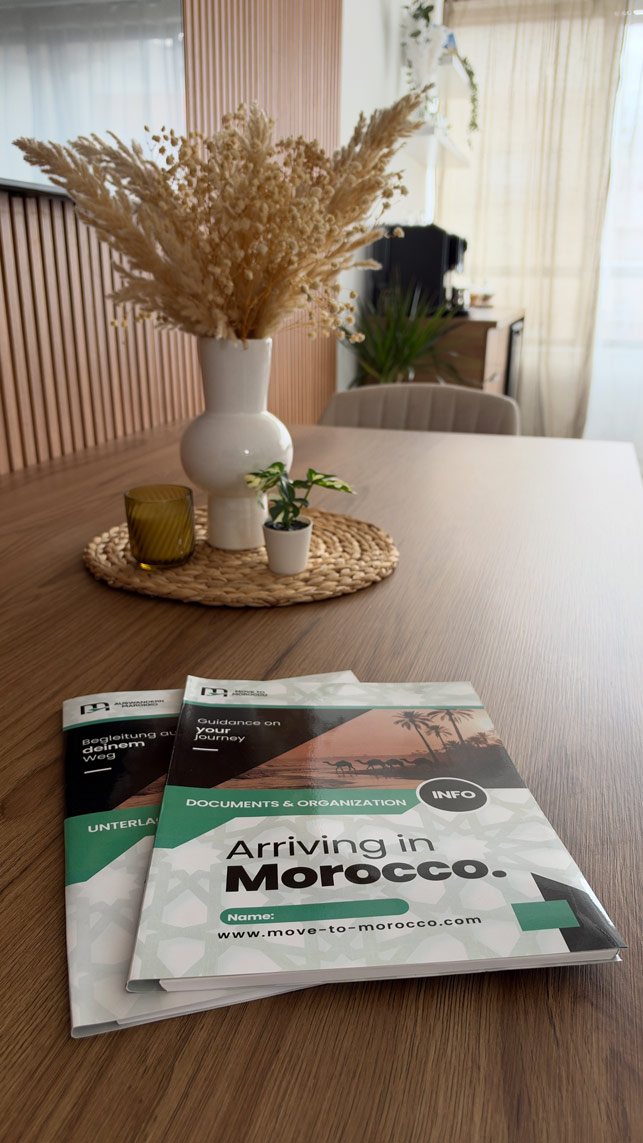
The English edition
Arriving in
Morocco.
Originals, copies and translations, brought together for your next appointment.
Your document’s starting point
One destination.
Different document routes.
Choose the country that issued your document and the kind of record you have. Start with the relevant authority, then confirm the form, language and timing with the recipient in Morocco.
Start with the UK Legalisation Office.
For an eligible UK document that needs an apostille for use in Morocco, the FCDO Legalisation Office is the starting point. Confirm whether the recipient needs the original or a particular certified copy before applying.
- Check the exact UK document and required format.
- Use the Legalisation Office if an apostille is required.
- Agree the translation of the completed document and its attached certification.
Match the authority to the document.
A state-issued birth or marriage certificate and a federal FBI record follow different routes. Where an apostille is needed, state vital records go to the issuing state’s competent authority; federal documents go to the U.S. Department of State.
- Identify the state or federal issuer.
- Obtain the accepted original or official certified version.
- Use the relevant apostille authority, then coordinate the translation.
Check where it was issued or notarised.
Canada has used the Apostille Convention since 2024. Depending on the document, Global Affairs Canada or a provincial authority handles the apostille. Federal records, including RCMP documents, and provincial documents need to be routed correctly.
- Identify the issuer and any province of notarisation.
- Follow the current GAC or provincial instructions.
- Confirm the recipient’s language and document-age requirements.
Do not order an apostille automatically.
France and Morocco have bilateral legalisation exemptions for the document categories covered by their arrangements. The French foreign ministry’s table identifies the relevant categories. Check that your actual document is covered and confirm its required form and translation.
- Identify the document category in the French official table.
- Check whether the bilateral exemption applies.
- Confirm the recipient’s accepted version and any translation.
Clarify legalisation for German documents.
The Apostille Convention does not apply between Germany and Morocco because of Germany’s objection. For a German public document, clarify the required legalisation and any preceding certification with the competent Moroccan representation.
- Confirm whether authentication is required for this document.
- Ask the Moroccan representation about the exact certification chain.
- Coordinate the final document and the accepted translation.
Find the competent Austrian authority.
The Austrian Embassy in Rabat identifies an apostille as the relevant authentication for Austrian public documents used in Morocco. The responsible Austrian authority depends on the document. Agree its accepted form and translation with the recipient.
- Identify the issuer and document category.
- Follow the Austrian authority’s apostille instructions if required.
- Prepare the language and format requested in Morocco.
Start with the Swiss issuing authority.
For public documents covered by the Convention, the apostille is the relevant route. A cantonal document and a federal document may involve different competent authorities. Use the Federal Chancellery’s current guidance to identify the right office.
- Identify the canton or federal issuer.
- Check the competent authority and required certification.
- Confirm the version and translation needed by the Moroccan recipient.
Use DFAT’s document guidance.
DFAT legalises Australian public documents through apostilles or authentication certificates. Some private documents need an Australian notary first. Check what the Moroccan recipient requires and which version DFAT can process before paying for certification.
- Distinguish the public document from a private record.
- Check DFAT’s preparation requirements and any notarial step.
- Agree the translation and complete set to present in Morocco.
Follow the Authentication Unit’s route.
New Zealand’s official country guidance lists Morocco under the apostille route. Check the Authentication Unit’s requirements for your particular New Zealand document, including any original, notarisation or document-format conditions.
- Check the document requirements before submitting it.
- Follow the official apostille application route for Morocco.
- Coordinate any translation with the receiving office.
Confirm the route for this issuing country.
Check whether the Apostille Convention is in force between the issuing country and Morocco, whether an exemption applies, and whether the document is covered. Otherwise, ask the competent authorities about the authentication and legalisation chain.
- Identify the country and authority that actually issued the document.
- Check the treaty relationship, document scope and any exemption.
- Confirm the required chain with the competent Moroccan representation.
- Confirm the recipient’s exact format and language.
- Ask which certification, if any, it needs.
- Arrange the accepted version and your local next step.
Keep the complete official version.
Check whether the recipient wants a full certificate, extract or official certified copy. Include attachments and name-change evidence where relevant.
Showing the starting point for a UK-issued public certificate.
Build the file around your plans
Which documents
might you need?
Use these groups to identify the questions for your move. They are possible documents for different purposes, rather than one mandatory list for every newcomer.
Identity & addressPassport, requested passport pages and address evidence.
Confirm the exact pages, accepted copies and evidence for your current address. A bank and a residence office may ask for different forms.
Police & criminal recordsA foreign police certificate or a Moroccan criminal record, where requested.
Check the issuing country, certificate type and accepted issue date. Plan authentication and translation around the actual submission window.
Family & civil statusBirth, marriage, divorce, name-change or parental documents.
Order the version relevant to your family’s situation. For children, ask the school or receiving office about its own record and translation requirements.
Income, pension & bankingPension letters, income records, bank evidence or a bank certificate.
Ask which issuer, period and format are accepted. Link the preparation to your account and intended application rather than assuming one bank letter works everywhere.
Work, study & businessQualifications, transcripts, employment papers or registry documents.
Confirm the employer’s, institution’s or registry’s exact request. Authentication of a qualification does not itself grant professional recognition or permission to work.
Representation & practical mattersA power of attorney, signed declaration or other purpose-specific record.
Confirm the text, recipient, signatory and accepted certification before signing. A signature certification and approval of the document’s legal effect are different matters.
For the application itself, continue with our Morocco residence-permit preparation guide. For a company, use the company-formation guide alongside the specific registry requirements.
Different tasks. A joined-up preparation.
Apostille. Translation.
Certified copy.
These words often appear together, but they do different jobs. Keeping them separate makes the order of preparation much easier to understand.
Apostille or legalisation
Also spelled legalizationConcerns the relevant signature, official capacity and seal or stamp. The document and country relationship determine the route; exemptions can apply.
Accepted sworn translation
Traducteur assermentéTransfers the document into the required language. Confirm the translator’s authorised language combination, the pages to include and the recipient’s acceptance.
Certified copy
Matching a copy to an originalConfirms correspondence with the presented original. A certified passport copy is a different task from authenticating a foreign birth or police certificate.
Signature certification
Confirming the signatureConcerns the signature on a declaration or other record. It does not decide whether the document’s wording achieves the legal result you intend.
The complete document matters. Before translation, agree whether attached apostilles, endorsements and stamps must be included. At collection, compare names, dates and references with the original.
Find a qualified translator by city and language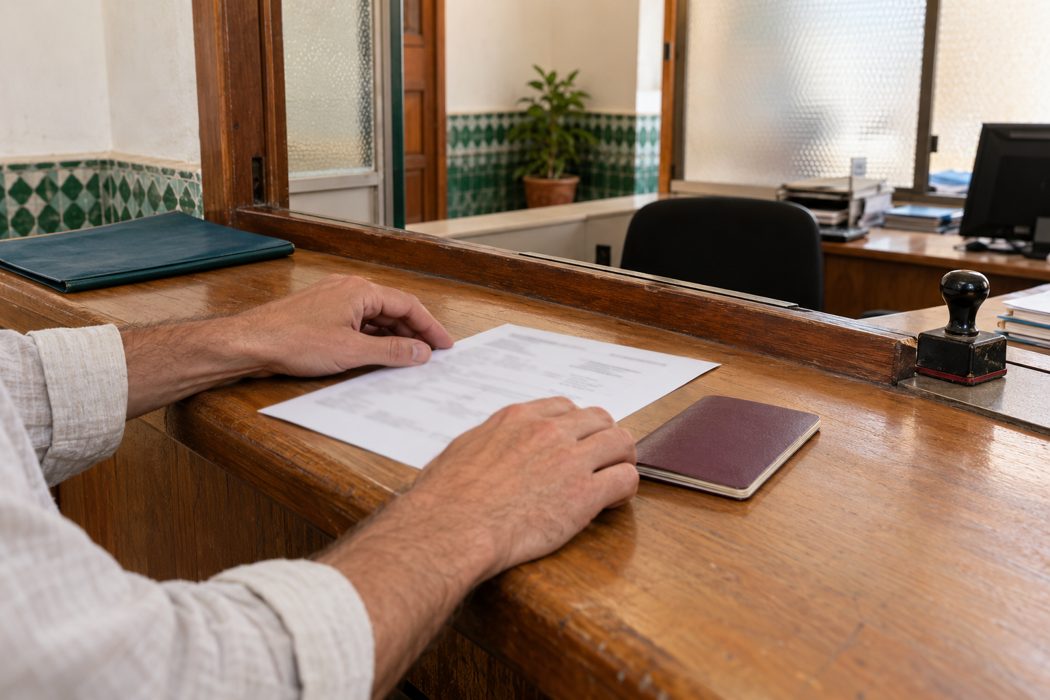
Practical steps in Morocco
At the local office,
the words matter.
You may hear “legalise the copy” when someone means a certified copy. We help you clarify the requested task and prepare for the appropriate local service.
Copie certifiée conforme
A copy checked against the original. Where required, prepare the original and clear copies of the requested pages.
Légalisation de signature
Signature certification is a separate service. Confirm the document, signatory and identification needed before attending.
Muqataa, Moqataa and Muqataâ are common spellings for the local district administration. We clarify the relevant service for your address and procedure.
Our document-preparation support
From a list of papers
to a clear next appointment.
You do not have to organise each step on your own. We prepare the practical work with you and accompany the local steps we agree together.
Go through what you already have.
We review the available originals, copies and translations with you, compare the names and references, and identify the preparation still needed.
Bring the steps into the right order.
We coordinate the agreed preparation, translation arrangements, copies and local appointments. You know which task belongs to which person or office.
Have someone beside you locally.
We accompany agreed appointments and help you work through practical follow-up. From our base in Tangier, we arrange relocation support across Morocco.
Tell us the country of issue, document type, purpose, Moroccan city and approximate timing. We agree the support and fee before starting.

Continue with practical support on the ground.
Prepare in the right place
Before you leave.
Once you arrive.
Some tasks depend on an authority abroad. Others belong to your appointments in Morocco. We connect the two parts around your actual timeline.
Before departure
Give the overseas steps a head start.
- Confirm the required records and their accepted issue dates.
- Identify the issuing authority and any authentication step.
- Check delivery, digital versus paper form and access to spare official copies.
In Morocco
Bring the file into local use.
- Coordinate the accepted translation and compare the completed pages.
- Prepare the requested passport copies, address and appointment evidence.
- Attend the agreed appointments with an organised file and clear follow-up.
A preparation you can take with you
Your document brief.
Ready for the next conversation.
Mark what you have prepared. Your PDF carries the country and document type selected above, the questions to confirm and your checklist. No personal document uploads are needed.
Your selection is a preparation aid. Confirm the final requirements with the office or professional receiving your documents.
Two branded A4 pages. Your selected starting point, useful questions and checklist.
30 questions
What documents do I need to move to Morocco?
Start with your passport and the documents relevant to your reason for moving. A residence application, bank appointment, school admission and company registration have different requirements. Use the document groups above to prepare your questions, then confirm the current list for each recipient.
Is this the same as a Morocco travel-document checklist?
No. This guide focuses on preparing documents for settling in and using them in Morocco. Passport, visa and entry conditions are a separate check based on your nationality and situation. If you are planning a longer stay, connect this preparation with your residence plan.
Should I prepare documents before travelling?
Start the checks before departure, particularly when records must be issued or authenticated abroad. Confirm the required issue date before ordering time-sensitive certificates. Leave room for translation, delivery and local appointments instead of obtaining everything too early.
Does my nationality determine the apostille route?
The issuing authority matters for the document’s authentication route. For example, a British citizen with a US-issued birth certificate needs to check the US document route. Your citizenship can still matter for the underlying procedure, so keep those two questions separate.
Can you help if I am already in Morocco?
Yes. We can review the preparation with you, identify what is already available and organise the agreed local steps. If a foreign authority must issue or authenticate a document, we help you plan that part around its actual procedures and delivery options.
Do I need an apostille on every document?
No. Check the document, the relationship between the countries and any exemption. A private financial record, passport copy and public certificate need different consideration. The recipient may accept a document without an apostille, or a different certification route may apply.
How do I prepare UK documents for Morocco?
For an eligible UK document that needs legalisation, consult the FCDO Legalisation Office. Check whether the recipient wants the original or a particular certified copy. The UK service does not legalise documents issued in another country. Coordinate any translation with the completed document.
Which UK police certificate should I prepare?
The UK government’s guidance for British residents in Morocco points to ACRO for a UK police certificate. Confirm the exact certificate with the receiving office, including its format and accepted issue date. Do not assume another background-check product, such as a DBS check, is the requested record.
Do US birth certificates and FBI checks use the same authority?
No. When an apostille is required, state-issued vital records normally go through the competent authority of the issuing state. Federal documents, including FBI background checks, use the U.S. Department of State route. Check the required version before submission.
What changed for Canadian documents?
Canada joined the Apostille Convention in 2024. Global Affairs Canada handles federal documents, including RCMP records, while designated provincial authorities handle other documents within their remit. Check the issuer and any province of notarisation. Older advice describing only a consular legalisation chain may no longer fit your document.
Do French documents always need an apostille for Morocco?
No. The French foreign ministry lists bilateral legalisation exemptions for the covered document categories between France and Morocco. Check the relevant category and the recipient’s required form. An exemption from authentication does not settle a separate translation requirement.
Can I use a German apostille for Morocco?
The Apostille Convention does not apply between Germany and Morocco because of Germany’s objection. Clarify any required legalisation and preceding certification with the competent Moroccan representation. Do not treat another country’s apostille checklist as the route for your German document.
What if my document comes from another country?
Identify its actual issuing authority, then check the current treaty relationship with Morocco and the document’s scope. Also check for exemptions. If the apostille route is unavailable, ask the competent authorities about the applicable authentication and consular legalisation steps.
Do documents need translation into French or Arabic?
Confirm the accepted language with the receiving office. English documents are not automatically accepted everywhere, and a French-language document does not answer every procedural question. Agree the required language, translator and complete set of pages before placing a translation order.
Where can I find a sworn translator in Morocco?
ATAJ provides a directory searchable by city and language. Check the translator’s authorised language combination and the recipient’s acceptance requirements. We help you organise the preparation and agreed appointments; the qualified translator produces and certifies the translation.
Should I get the apostille before the translation?
Confirm the complete sequence for your document. Often the translator needs the document with its final certification and attached pages. A translation made abroad can have its own certification requirements. Check the recipient’s and translator’s instructions before paying for either step.
Does the apostille itself need to be translated?
Ask whether the recipient wants the attached apostille, stamps, endorsements and other pages included. Give the translator the complete set. A translation of the main certificate alone may leave out information the receiving office wants to see.
Can I use a PDF, e-apostille or printed police certificate?
Keep the digital original as issued and check acceptance with both the receiving office and the relevant authentication authority. Ask whether the digitally signed file or a particular paper version is required. Do not assume a home printout has the same status as an official copy.
What should I check when collecting a translation?
Compare names, dates, places and document references with the original. Check that all required pages and endorsements are included, and that the translation has the necessary identification and certification. Raise a discrepancy before the next appointment.
What does Muqataa mean in document preparation?
Muqataa, also written Moqataa or Muqataâ, is commonly used for a local district administration. The relevant municipal service may be involved when a certified copy or signature certification is actually required. Confirm the service and responsible office for your address before going.
How do I prepare a certified passport copy?
Ask which pages and type of copy the recipient requires. If local certification is needed, prepare the original passport and clear copies for the competent service. We can help organise the copies and the agreed appointment as part of your preparation.
Is a certified copy the same as legalising a foreign certificate?
No. Copy certification checks a copy against the presented original. Authentication of a foreign public document concerns the relevant signature, seal and issuing authority. A local stamp on a passport copy does not replace a required apostille or legalisation of another certificate.
How recent must police certificates and other records be?
Ask the actual recipient for its accepted age and the date at which it measures that age. Different documents and procedures can have different rules. Work backwards from the intended submission date; there is no single freshness period to apply to the whole folder.
How many photographs and document copies should I bring?
Use the current instructions for your procedure and local office. Confirm the photograph specification, number and whether plain or certified copies are required. A general internet checklist should not decide how many copies or photos you pay for.
What should families prepare for children?
Ask about each child’s passport, civil-status records and the records requested by the chosen school. Where relevant, clarify parental authority, consent and name differences. A school’s enrolment file and a parent’s residence file are separate requests; prepare each around the named recipient.
What does your document-preparation service include?
We go through the available documents with you, structure the preparation, coordinate the agreed translation and copy-related steps, and arrange personal accompaniment for agreed appointments. We clarify who handles each action and keep the follow-up practical. Official certifications remain with the authorised professionals and offices.
Can we start while I am still abroad?
Yes. Start with the issuing countries, document types, Moroccan city, purpose and approximate timing. We can structure the next steps before you travel, then connect them with the local appointments once you arrive. You do not need to upload identity documents to this page’s navigator.
What do apostilles, translations and your support cost?
Costs depend on the issuing authority, document, language, delivery and support agreed. We separate official charges and professional translation costs from our own service fee. Confirm the scope and charges before authorising the work; a single flat document price would be misleading.
How do documents connect with housing, banking and residency?
A confirmed address, suitable bank evidence and your residence purpose can affect different parts of the preparation. We help connect the steps so that one appointment supports the next. Use our housing, bank-account and residence guides to plan those related tasks.
Can I download my preparation without giving personal details?
Yes. The preparation brief uses your country and document-type choices and the checklist items you mark on this page. It downloads directly as a branded PDF. The navigator does not ask for names, passport numbers or copies of your documents.
No matching question yet.
Try a shorter term, choose another topic or clear the search. You can also discuss your situation with our team.
Official references & editorial review
Reviewed in November 2026. Country guidance below supports the distinctions in this guide. The authority or professional receiving your document confirms its current requirements. We keep document preparation separate from entry eligibility, work permission and the decision on an application.
- Apostilles & exemptionsHCCH: Convention and scope
- Apostilles & exemptionsHCCH: current country status
- Apostilles & exemptionsFrance: bilateral exemptions table
- Apostilles & exemptionsGermany: objection concerning Morocco
- Country authoritiesUK Legalisation Office
- Country authoritiesUSA: state and federal documents
- Country authoritiesCanada: federal and provincial routes
- Country authoritiesAustralia: DFAT guidance
- Country authoritiesNew Zealand: overseas-use guidance
- Country authoritiesAustria: Embassy in Rabat
- Country authoritiesSwitzerland: Federal Chancellery
- Preparation in MoroccoBritish residents: official Morocco guidance
- Preparation in MoroccoATAJ: qualified translator directory
- Preparation in MoroccoMoroccan Ministry of Justice: professional resources

Your move. Personally supported.
An organised file.
Someone by your side.
Bring the questions you have. We help you structure the documents, coordinate the practical preparation and plan the agreed appointments in Morocco.
Still abroad or already in Morocco? Start with your purpose, city and approximate timing.